
A business traveller leaving an office in central London can reach Paris without setting foot in an airport. Eurostar connects St Pancras International with Gare du Nord, placing passengers within easy reach of both cities’ business districts. Yet travelling by train is not always the most convenient solution. For executives attending several meetings, groups following tight schedules or passengers continuing to another destination, a private aircraft may offer advantages that are less obvious when comparing journey times alone.
The decision between rail and air depends largely on where the journey begins and ends. A passenger travelling from King’s Cross to central Paris has different requirements from someone leaving a business park in Surrey for a meeting outside the French capital. Private charter services such as RentJet allow travellers to request flight arrangements around their itinerary, including a choice of departure airport and aircraft. Whether that flexibility justifies the additional expense requires a closer examination of the complete journey.
The flight between London and Paris is short, but flying involves much more than the time spent in the air. Ground transfers, terminal procedures, airport restrictions and onward transport can all influence the result. Eurostar has its own boarding requirements, although its central stations eliminate many of the transfer arrangements associated with aviation. The better option depends on how these factors combine for an individual traveller.
Comparing the Complete Journey Time
Eurostar’s fastest services connect London and Paris in approximately two hours and sixteen minutes. Trains depart from St Pancras International and arrive at Gare du Nord, with both stations connected to extensive urban transport networks. Travellers staying or working near either station can often reach their final destination without a lengthy additional journey.
However, the published train duration does not include the time required before departure. Eurostar currently recommends arriving at St Pancras 75 minutes before departure for Standard and Plus passengers, while Premier travellers are generally advised to arrive 45 minutes early. These recommendations allow time for security, passport and border checks. Passengers must follow the guidance on their tickets, as requirements may change.
Private aviation uses a different operating model. Passengers generally depart through dedicated business aviation facilities rather than the main commercial terminals. This can reduce the time spent at the airport before boarding, although security, customs and immigration requirements still apply. The charter operator confirms the necessary arrival time according to the airport and flight arrangements.
The flying distance between the two capitals is relatively short. Nevertheless, the actual journey depends on the selected airports, aircraft performance, air traffic procedures and weather conditions. Taxiing, departure routing and the approach into Paris add time beyond the aircraft’s cruising phase. An advertised flight duration should therefore not be treated as a guarantee of the complete travel time.
For a passenger leaving central London, reaching an airport such as Farnborough or Luton may take longer than reaching St Pancras. On arrival in France, additional road transport is needed between the airport and the destination. These transfers can offset much of the time saved through faster boarding and a short flight.
A practical comparison should start at the passenger’s actual departure address and finish at the meeting venue, hotel or residence in Paris. Only then does it become clear whether chartering an aircraft offers a genuine time advantage.
Choosing the Right Airports for a Private Flight
Private jet departures from London can be arranged through several business aviation airports. Biggin Hill, Farnborough, Luton and Stansted are among the options, although their suitability depends on aircraft availability, operating restrictions and the traveller’s starting location. The closest airport is not necessarily the cheapest or most convenient, particularly when an aircraft must be repositioned before the flight.
For passengers based in south or southeast London, Biggin Hill may provide a practical departure point. Farnborough can suit travellers coming from Surrey and southwest London, while Luton is worth considering for those based farther north. Stansted may be useful for passengers travelling from Essex or northeast London. Road conditions and the proposed flight schedule should be considered alongside geographical distance.
On the French side, Paris–Le Bourget is a major business aviation airport. Situated north of the city, it specialises in private and corporate aircraft operations and offers dedicated passenger handling facilities. Its location provides access to Paris and surrounding business districts, although journey times by road vary according to traffic and the precise destination.
Paris Charles de Gaulle and Orly may also accommodate certain private aviation operations, subject to airport facilities and operational requirements. These airports are not interchangeable simply because they serve the same city. A charter broker must confirm which facilities can handle the selected aircraft and whether the proposed arrival time is available.
Le Bourget can be particularly relevant for passengers heading to northern Paris, nearby business locations or destinations outside the city centre. Someone travelling directly to a hotel near Gare du Nord, however, may find that Eurostar offers a much simpler final connection. The destination within Paris can therefore be as important as the departure point in London.
Airport selection also affects the charter quotation. Landing and handling charges vary, while an aircraft based at one London airport may require an additional flight to collect passengers elsewhere. Selecting an alternative airport can sometimes reduce positioning expenses, although any financial saving should be weighed against the ground transfer.
When a Private Jet Has a Practical Advantage
The strongest argument for private aviation is not necessarily speed. It is the ability to arrange transport around a schedule that commercial services cannot accommodate conveniently. For certain business journeys, controlling the departure time and travelling directly between suitable airports may be more valuable than reducing the time spent in transit.
Consider a group of executives attending meetings at several locations. They may need to leave London early, spend part of the day outside central Paris and return after the final appointment. A charter can potentially be arranged around that programme, provided airport hours, aircraft availability and crew operating limits permit. The group can also travel together rather than coordinating separate railway bookings.
Privacy may be another consideration. A private cabin provides a more controlled environment for discussions than a public train carriage, although passengers must still consider information security when handling confidential documents or using communication systems. The aircraft can also provide a suitable setting for reviewing presentations or discussing the next meeting, depending on its cabin configuration.
Group travel changes the financial comparison as well. A charter quotation generally covers the entire aircraft rather than individual seats. Although the total will usually exceed the price of standard railway tickets, the cost can be assessed against the number of passengers and the business requirements of the trip. For a single traveller, the financial difference is likely to be much harder to justify.
Private charter may also be useful for itineraries that continue beyond Paris. An aircraft can potentially serve another European destination after a meeting, avoiding the need to return to a major railway station or coordinate separate commercial connections. These multi-city journeys require additional operational planning, but they illustrate an advantage that cannot be measured through a simple London–Paris comparison.
Several circumstances make private aviation worth considering.
- Multiple passengers travelling together. A group can share the same schedule and move between airports and meeting locations as one party.
- Meetings outside city centres. A suitable arrival airport may provide more convenient access to a destination beyond central Paris.
- Time-sensitive itineraries. Charter passengers can request departure times that correspond with their commitments, subject to operational approval.
- Multi-destination business travel. One aircraft may be able to accommodate several flights within a coordinated itinerary.
- Specific privacy requirements. Travelling in a private cabin can provide greater control over the passenger environment.
None of these advantages applies equally to every journey. A private aircraft may offer little benefit to an individual attending a single meeting near Gare du Nord. Its usefulness increases when the itinerary becomes more complicated or involves several passengers with shared commitments.
Why Eurostar Often Makes More Sense
Rail travel has a substantial geographical advantage on this route. St Pancras International and Gare du Nord are located within the urban areas they serve, reducing the need for long airport transfers. Both stations connect with local transport, allowing passengers to continue by Underground, Métro, taxi or other services.
For a traveller based near central London, reaching St Pancras can be straightforward. On arrival in Paris, Gare du Nord provides access to several neighbourhoods and business districts. Even after accounting for recommended pre-departure checks, the train can offer a competitive door-to-door journey compared with flying privately.
Price is another important difference. Standard railway tickets are generally much less expensive than chartering an entire aircraft. Travellers can choose between different service classes according to their budget and requirements, while the cost of a private jet reflects aircraft operation, crew, airport charges and other expenses.
Eurostar also offers a practical working environment. Passengers can read documents, prepare presentations or use available connectivity during the journey, although service quality and mobile reception may vary. For many professionals, more than two hours aboard a train provides a useful uninterrupted period without the additional transitions between airports, vehicles and aircraft.
Luggage arrangements may favour rail for certain journeys. Eurostar permits passengers to carry luggage within its published allowances without the aircraft-specific weight and storage constraints associated with smaller business jets. Nevertheless, travellers with unusually large items should check the railway operator’s current baggage rules before booking.
Environmental considerations also deserve recognition. Rail generally has substantially lower greenhouse gas emissions per passenger than private jet travel on a short route, although precise comparisons depend on aircraft type, occupancy and the calculation method. For companies with travel-emissions policies, this difference may influence the choice independently of price or convenience.
The train does impose scheduling constraints. Passengers must choose an available departure and comply with ticket conditions, while the last service of the day may not suit a late meeting. However, scheduled departures and central stations make Eurostar a strong choice for straightforward journeys between the two capitals.
Understanding the Financial Difference
Comparing a private charter with Eurostar requires more than placing two ticket prices side by side. Rail passengers normally purchase individual tickets, with fares varying according to travel date, booking conditions and service class. Private aviation operates on a whole-aircraft basis, with pricing influenced by the aircraft, route and operator’s schedule.
The cost of a London–Paris charter can include fuel, crew expenses, airport handling, taxes and aircraft positioning. A jet that is already available at the departure airport may produce a different quotation from one that needs to arrive from another location. Aircraft category also matters, although a short route does not necessarily require a large or long-range jet.
Return journeys introduce another variable. The operator must determine whether the aircraft should remain in Paris, return to its base or continue to another assignment. Aircraft waiting time and repositioning requirements can affect the overall quotation. Passengers should therefore compare complete return-trip arrangements rather than assuming that two one-way flights will be priced independently.
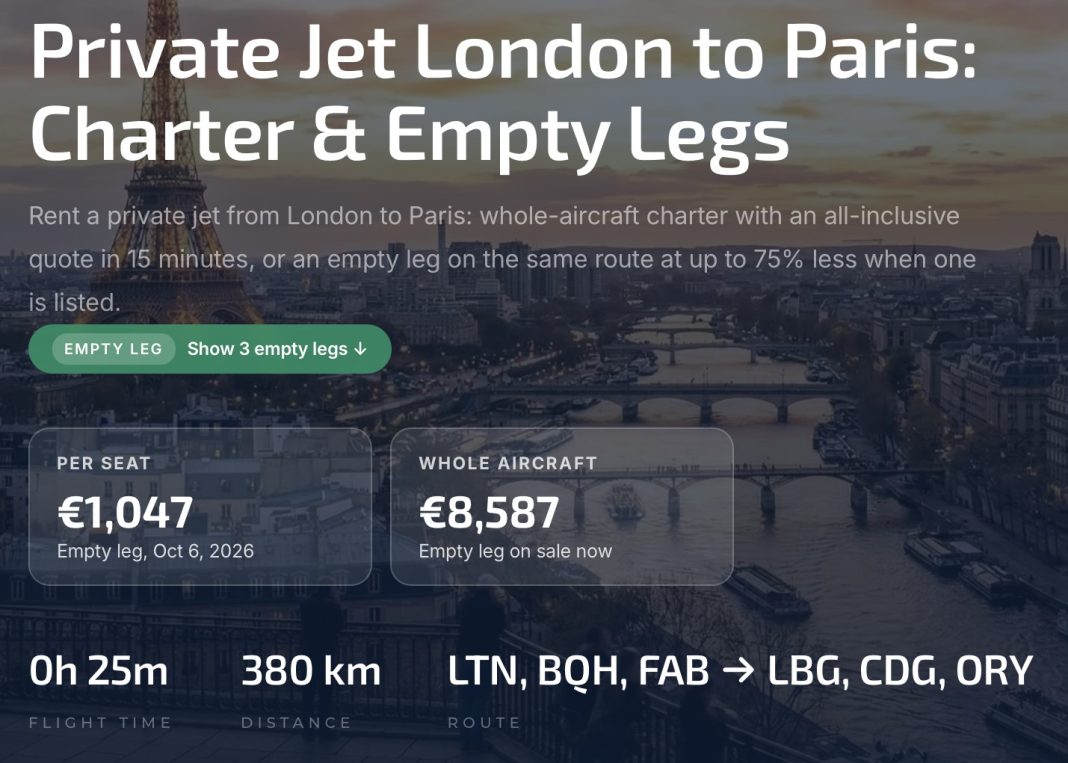
Empty leg flights offer a possible alternative. These occur when an aircraft must reposition without its original charter passengers and the operator makes the available capacity available at a reduced price. Discounts may reach 75% compared with conventional charter rates, but passengers have much less control over the route and schedule.
An empty leg is unlikely to provide the certainty needed for every business appointment. Its availability depends on another aircraft movement, which may be changed or cancelled. It is more suitable for travellers who can adjust their plans than for those attending an event at a fixed time.
For business groups, it can be useful to calculate the effective charter cost per traveller, but this figure should not be mistaken for a publicly available seat fare. The entire aircraft may have to be booked regardless of how many passengers occupy it. Any comparison should also include airport transfers, waiting time and the value of having the group arrive together.
Making the Right Decision for the Journey
The simplest way to choose between Eurostar and private aviation is to start with the itinerary rather than the mode of transport. A passenger travelling from a central London office to a meeting near Gare du Nord may find that rail provides the shortest and least complicated overall journey. The situation changes when several executives need to visit a business location outside Paris and return to London at a time that does not correspond with the railway timetable.
Departure and arrival addresses should be examined before comparing published journey durations. A short flight can lose its advantage through lengthy airport transfers, while a train journey can be exceptionally convenient when both locations are close to the stations. Equally, a private aircraft departing near the traveller’s home and landing close to a regional destination may eliminate considerable ground travel.
The size of the travelling party required arrival time and onward arrangements are also important. Groups may benefit from coordinated transport, while individual travellers often have less reason to pay for an entire aircraft. Those making several stops should consider whether a single charter can simplify the programme enough to justify the expense.
Reliability should not be reduced to assumptions about either mode of transport. Trains can experience disruption, while private aircraft remain subject to weather, air traffic restrictions, technical requirements and airport availability. Travellers with important commitments should build a sensible margin into their schedule regardless of how they travel.
London and Paris are close enough for the train to compete effectively with aviation, even when private terminals and flexible departure arrangements are available. That makes this route a useful example of why the fastest vehicle does not always produce the most convenient journey.
For straightforward city-centre travel, Eurostar will often be the more practical and economical option. Private charter becomes more compelling when passengers need greater control over their schedule, are travelling as a group or have a more complicated itinerary. The deciding factor is not how quickly the aircraft crosses the Channel, but how efficiently the traveller reaches the intended destination.