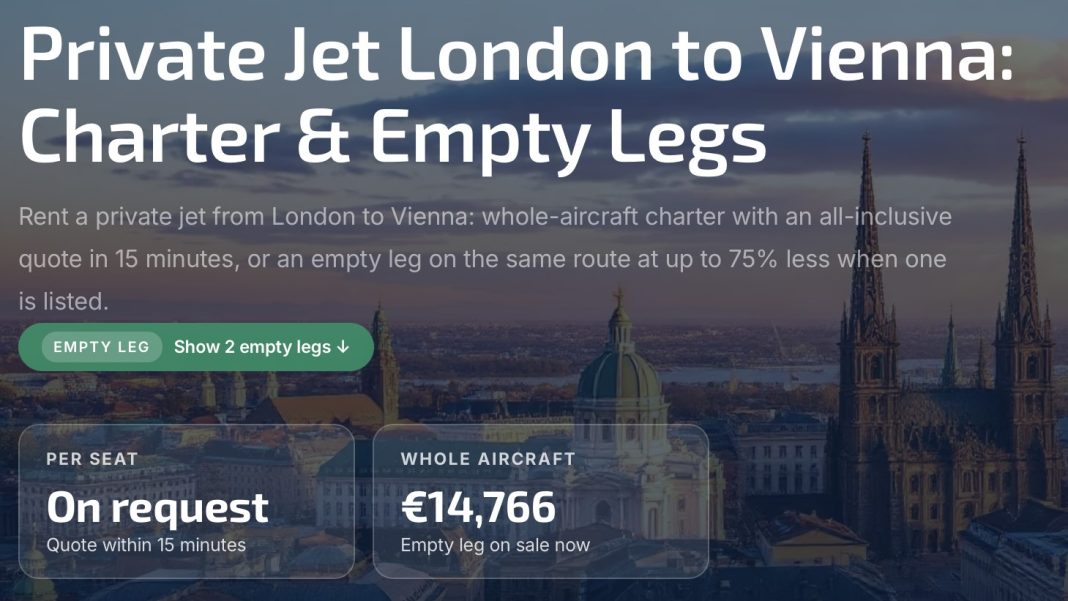

Vienna attracts visitors whose schedules rarely fit neatly around airline timetables. International business meetings, diplomatic engagements, cultural events and private holidays all bring travellers to the Austrian capital. For passengers who need to coordinate several appointments or travel with a group, a direct charter can offer greater control over departure arrangements. Those considering a private jet from London to Vienna (https://rentjet.eu/routes/london-to-vienna) can choose an itinerary built around their preferred schedule, subject to aircraft availability and airport operating conditions. The journey is relatively short by European aviation standards, but selecting the right airports and aircraft can make a considerable difference to the overall experience.
The air distance between London and Vienna is approximately 1,280 kilometres, making the route suitable for a range of business jets. Flight duration is generally around two to two and a half hours, depending on the aircraft, departure airport, weather and air traffic arrangements. This makes Vienna accessible for a short business visit or a longer stay without requiring a connection through another European hub. Private aviation also gives passengers the opportunity to travel together in a cabin reserved for their group, with departure arrangements agreed in advance.
Vienna itself offers several reasons to consider a carefully planned itinerary. The city hosts international organisations, corporate headquarters, financial institutions and major cultural events. Its position in Central Europe also makes it a practical starting point for journeys to other Austrian destinations or neighbouring countries. For visitors with limited time, reducing unnecessary airport transfers and coordinating ground transport before arrival can be more valuable than a modest reduction in flight duration.
Choosing a Departure Airport in London
London’s extensive airport network gives charter passengers several departure options, although they are not interchangeable. Farnborough, Biggin Hill and Luton are among the established airports used by business aviation operators. Each serves a different geographical area, and the most convenient choice depends on where passengers begin their journey. An airport that works well for someone travelling from central London may be less suitable for a family departing from Surrey or a business group based in Kent. Aircraft positioning, operating hours and airport charges can also influence the recommendation.
Farnborough Airport, southwest of London, concentrates on business aviation and provides dedicated facilities for private aircraft. Its location can be convenient for passengers travelling from Surrey, Hampshire and western parts of the capital. London Biggin Hill Airport, southeast of the city, is another established business aviation facility, particularly relevant for travellers from Kent and south London. Both airports operate under specific conditions that must be considered when arranging departure times and selecting aircraft.
London Luton offers a further alternative north of the capital. Alongside its commercial airline operations, it has specialist facilities for private aviation and accommodates a broad range of business aircraft. Its location may suit passengers travelling from north London, Hertfordshire or surrounding areas. However, road congestion can affect access to the airport, particularly during peak periods. A charter quotation should therefore be assessed alongside the expected journey from the passenger’s home, office or hotel.
The choice of airport can also affect the aircraft available for the flight. A jet already positioned at one London airport may be more economical than an equivalent aircraft that must travel from another location to collect passengers. In some circumstances, a slightly longer ground transfer can reduce overall costs without significantly changing the travel schedule. Conversely, a conveniently located airport may justify a higher quotation when time is particularly valuable. Comparing the full itinerary provides a more useful basis for deciding than focusing on the departure airport alone.
Arriving in Vienna
Vienna International Airport, located in Schwechat southeast of the city, is the principal international gateway for the Austrian capital. It accommodates scheduled airline services and private aviation, with dedicated facilities for business aircraft and their passengers. The airport’s VIP and General Aviation Terminal is situated in the western part of the airport grounds. Specialist handling arrangements can help coordinate passenger reception, baggage and onward transport. These services should be confirmed with the charter provider before departure.
The journey from the airport to central Vienna is usually straightforward, although the time required depends on traffic and the final destination. Passengers attending meetings in the historic city centre may prefer a prearranged chauffeur service, while travellers staying outside Vienna could benefit from a vehicle collecting them directly from the appropriate terminal. It is important to give the transport provider the correct private aviation meeting point rather than assume that arrival procedures are identical to those used by scheduled airlines.
Vienna also provides access to a wider region of Austria and Central Europe. Travellers may continue towards the Wachau Valley, Austrian business centres or destinations across nearby national borders. For journeys involving several locations, it may be worth discussing whether returning to Vienna Airport is the most efficient option. Depending on the intended route and aircraft availability, another suitable airport could potentially serve a later departure.
International travel formalities remain relevant to private passengers. The United Kingdom is outside the Schengen Area, so travellers arriving from London must comply with the applicable passport and immigration procedures. Entry requirements depend on nationality, residence status and the purpose of the visit. Private aircraft passengers are not exempt from these requirements, even when using dedicated terminals. Checking documentation in advance helps avoid delays that cannot be solved by adjusting the flight schedule.
Selecting an Aircraft for the Route
The London–Vienna journey does not ordinarily require an aircraft designed for intercontinental flights. Many light and midsize business jets have sufficient range to operate the route without a refuelling stop under suitable conditions. The appropriate choice depends on passenger numbers, baggage, required cabin space and the airports involved. A smaller aircraft may be practical for two or three executives travelling with modest luggage, while a larger group may need additional seats and storage capacity. Comfort preferences can also influence the decision, particularly when passengers intend to work during the flight.
Several factors are worth discussing before requesting a final aircraft quotation.
- Passenger capacity. The aircraft must accommodate everyone travelling, with seating arrangements appropriate for the group.
- Baggage allowance. Large suitcases, sporting equipment and specialist items should be declared before aircraft selection.
- Cabin configuration. Available workspace, seating layout and cabin height can affect comfort and productivity.
- Airport compatibility. Runway requirements and operating restrictions may limit the aircraft suitable for a particular departure point.
- Onboard facilities. Wi-Fi, catering and lavatory arrangements vary between aircraft and should be confirmed individually.
Light jets can provide an efficient solution when passenger numbers are modest and the journey does not require extensive onboard facilities. Their cabins are generally smaller than those of midsize aircraft, and luggage capacity deserves careful consideration. For a business group intending to review documents, hold discussions or travel with substantial baggage, a midsize jet may offer a more comfortable environment. Larger aircraft are also available, although their additional capacity comes with higher operating costs.
Choosing a more expensive aircraft does not necessarily produce a meaningful improvement for every passenger. On a flight of roughly two hours, the ability to depart from a convenient airport and travel at the required time may matter more than having an exceptionally spacious cabin. A practical aircraft selection balances comfort against the actual requirements of the journey. Charter providers should be able to explain why a proposed aircraft is suitable rather than relying solely on its brand or category.
Understanding Charter Prices and Booking Arrangements
Private charter prices are calculated according to the aircraft and the operational requirements of the flight, not simply the distance between two cities. Aircraft category, flight duration, airport handling, crew arrangements and availability all influence the final quotation. The location of the aircraft before departure can be particularly important. If a jet must travel to London from another airport, that positioning flight may be reflected in the price. The same principle can apply after passengers disembark in Vienna.
A one-way charter and a return journey can therefore have very different pricing structures. For a short visit, the operator may need to determine whether the aircraft should remain in Vienna or travel elsewhere before collecting the passengers again. Parking charges, crew accommodation and additional aircraft movements can affect the cost of waiting. For longer stays, arranging two separate flights may sometimes be more appropriate. There is no universal rule, so the timing of the return journey should be included in the initial enquiry.
Passengers with flexible schedules may also consider empty leg opportunities. These arise when an aircraft needs to reposition without passengers before or after another charter assignment. Operators sometimes offer these flights at a reduced price because the aircraft would otherwise complete the journey empty. However, the departure date, airport and timing are generally determined by the existing aircraft schedule. An empty leg is therefore a different proposition from a conventional private charter arranged around the passenger’s requirements.
The main limitation is reliability of availability rather than the quality of the aircraft itself. A repositioning flight may depend on another booking, and changes to that booking can affect the empty leg. Travellers attending an important conference, wedding or business meeting should consider the consequences of a cancellation or schedule adjustment. A discounted flight may be attractive for a flexible leisure visit but less appropriate when arrival at a particular time is essential.
Before confirming any charter, passengers should examine the complete quotation and booking conditions. The agreement should identify the operating company, aircraft arrangements, itinerary, services included and applicable cancellation provisions. Ground transport, catering and other additional requirements should be discussed before payment. A clear understanding of these details makes it easier to compare competing offers and reduces the likelihood of unexpected costs.
Making the Journey Work Around Your Schedule
The practical value of private aviation becomes clearer when the entire London–Vienna itinerary is considered. A business traveller may need to leave London after an early meeting, reach Vienna for an afternoon appointment and return the following day. A family may place greater importance on travelling together, avoiding connections and arranging convenient onward transport. The same route can therefore call for different aircraft, departure airports and flight schedules. Identifying these priorities before requesting quotations helps the charter provider propose suitable arrangements.
Passengers should allow time for ground transport, terminal procedures and any immigration requirements, even when travelling through private aviation facilities. Flight plans remain subject to air traffic control, weather and airport operating conditions. Departure flexibility does not mean that an aircraft can leave at any moment without prior coordination. The most effective arrangements combine the freedom of a personalised schedule with realistic allowances for the operational requirements of international aviation.
London and Vienna are well connected by scheduled airlines, which remain a practical choice for many individual travellers. A private charter becomes more compelling when several passengers need to travel together, when commercial schedules create inconvenient gaps or when ground transfers and connections consume a disproportionate amount of time. Comparing the total journey cost with the benefits of a tailored itinerary provides a sounder basis for the decision than comparing ticket prices alone.
For travellers whose plans justify a charter, careful preparation is the key to a successful journey. Choosing an appropriate London airport, selecting an aircraft that meets the group’s requirements and arranging arrival services in Vienna can remove unnecessary complications. The flight itself may last little more than two hours, but its real convenience depends on the decisions made before departure. A well-planned private journey should allow passengers to concentrate on their purpose for travelling rather than the logistics required to reach their destination.